1.1
Mechanical tension is the main driver of hypertrophy.
three mechanisms are proposed for muscle growth: mechanical tension, metabolic stress, and muscle damage.
mechanical tension is the primary one. it's the force applied to the muscle when loaded —
especially in a lengthened position. the pump, the burn, the soreness — side effects, not the signal.
exercise selection should center on loading muscles at stretch. [1]
1.2
Volume drives hypertrophy — with a ceiling.
10 – 20
sets / muscle / week
dose-response is real: more sets → more growth, up to a recoverable limit.
below ~10 sets/week per muscle you're leaving gains untouched.
above ~20 sets/week you're accumulating fatigue without adding stimulus.
10–15 sets is the practical sweet spot for most people.
[2] [3]
1.3
Frequency is a volume distribution tool. That's it.
training a muscle 2× per week beats 1× when weekly volume is equal.
not because the muscle needs the signal twice — because two moderate sessions are higher quality
than one brutal one. 2× per week is the evidence minimum. 3× is fine. [4]
1.4
Rep ranges don't matter as much as proximity to failure.
| Range | Hypertrophy? | Tradeoff |
|---|
| 5 – 8 |
works |
high joint/CNS load |
| 8 – 15 |
optimal |
best effort-to-recovery ratio |
| 15 – 30 |
works |
very fatiguing mentally |
hypertrophy is rep-range agnostic. what matters is effort relative to failure — not the count.
the "8-12 zone" is practical, not magical. [5]
1.5
Stop 1–3 reps before failure, not at it.
RIR = reps in reserve. RIR 1–3 produces the same hypertrophy as failure
with significantly less accumulated fatigue and injury risk over weeks.
training to failure every set kills your weekly volume capacity. [6] [7]
RIR 0
failure — not needed
RIR 3
early sets / conservative
1.6
Stretch overload. The most underused principle.
exercises that load a muscle at its longest length produce more hypertrophy per set
than the same exercise in a shortened position. this came out of research in the early 2020s
and basically changed exercise selection thinking. [8]
incline curl > standing curl · overhead extension > pushdown ·
RDL > leg curl · deep squat > partial squat.
if two exercises train the same muscle, pick the one that stretches it more. [9]
1.7
Progressive overload is non-negotiable.
muscles adapt to whatever load you give them. same weights every week = no growth.
overload means consistently increasing the demand: more weight, more reps, better ROM.
rule: hit the top of your rep range for 2 sessions in a row → add 2.5 kg.
write your sessions down. [10]
for each muscle: 2–3 exercises chosen by biomechanics, stretch position, and non-redundancy.
no 8-exercise chest days. selection quality beats selection quantity.
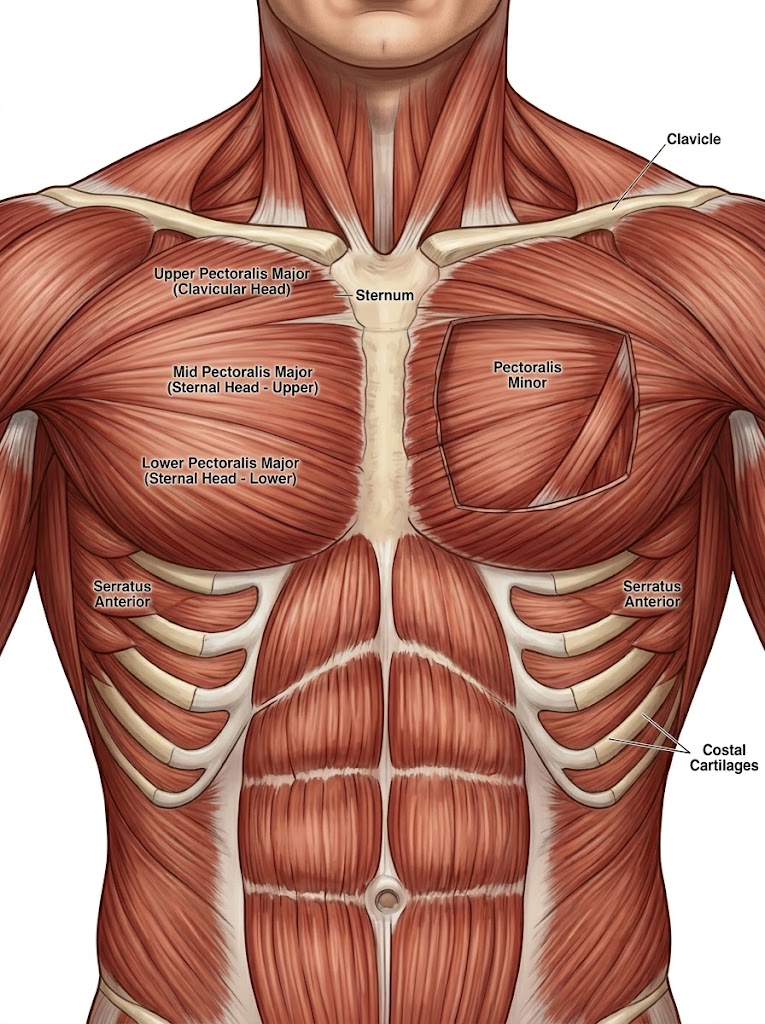
— chest
Pectoralis Major
chest.png
Clavicular + Sternal Head
1 — Incline bench press machine (30–45°) OR incline db press
compound
incline shifts emphasis to the clavicular (upper) head while still hitting the sternal head.
this single exercise covers most of the pec major.
dumbbells allow greater ROM and adduction at top. [11]
2 — Cable pec deck
isolation
cables maintain constant tension through full ROM.
[12] [8]
why flat bench is mostly redundant
context
flat bench loads the sternal head — already covered by incline at 30-45°.
adding flat bench on top of incline + fly duplicates stimulus and adds shoulder impingement risk.
keep it if you compete in powerlifting. otherwise, skip it. [11]
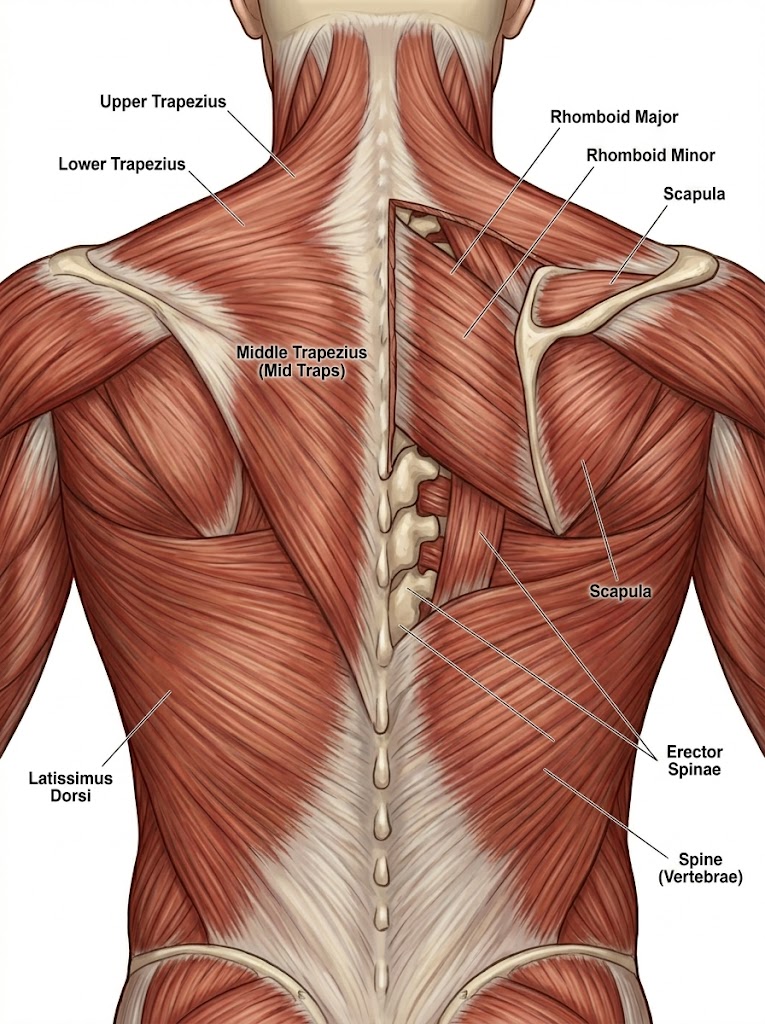
— back
Latissimus Dorsi + Mid Traps + Rhomboids
back.png
Lats · Mid Traps · Rhomboids
1 — Pull-Up or Lat Pulldown
compound
vertical pull for lat width. shoulder-width grip maximises lat stretch at the top.
pull-up and pulldown are equivalent for lat hypertrophy — use whichever lets you load progressively.
[13]
2 — Chest-Supported Row or Cable Row
compound
horizontal pull for mid-back thickness. chest-supported removes lower back fatigue —
important if you're also squatting and deadlifting the same week. [14]
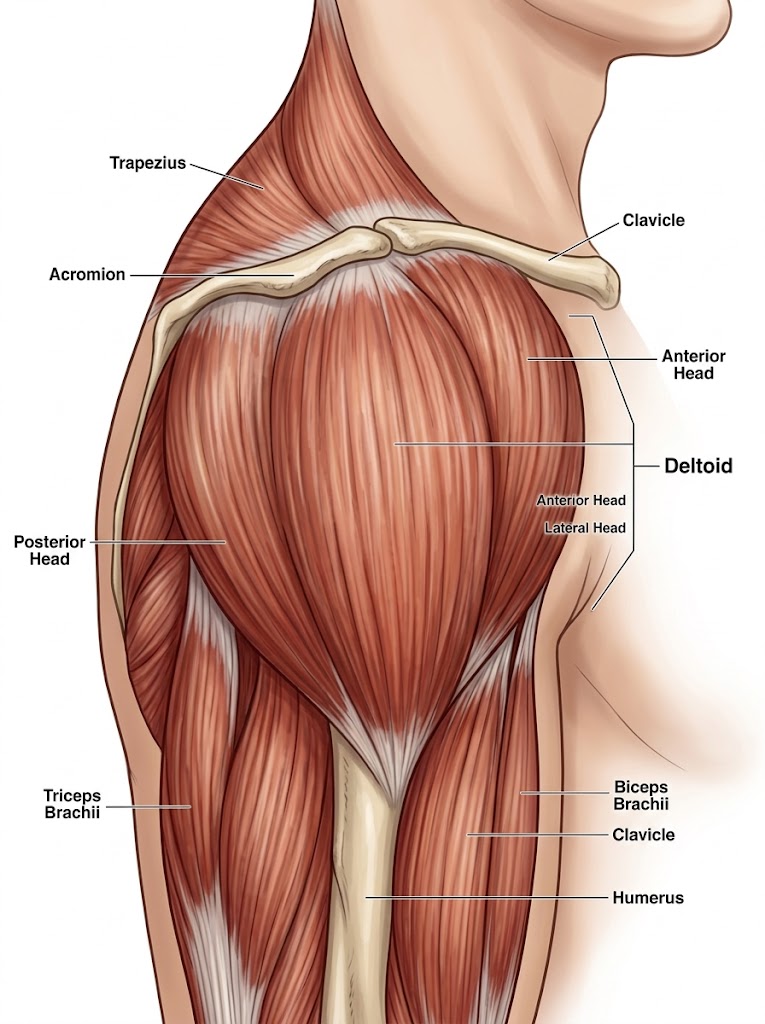
— shoulders
Deltoids
shoulder.png
Anterior · Lateral · Posterior Head
1 — Overhead Press (DB or BB)
compound
most efficient shoulder exercise. anterior and lateral heads under heavy load simultaneously.
note: anterior delt is already getting volume from pressing (incline, bench) —
OHP mainly justifies itself here for lateral head and total shoulder mass. [15]
2 — Cable Lateral Raise
isolation
shoulder width = lateral head. cable keeps tension at the bottom (muscle stretched),
unlike dumbbells where tension drops to zero at your side. [16]
3 — Rear Delt Fly (cable or pec deck reversed)
isolation
posterior delt is almost never hit enough. presses and rows don't isolate it.
required for shoulder balance and long-term joint health. [17]
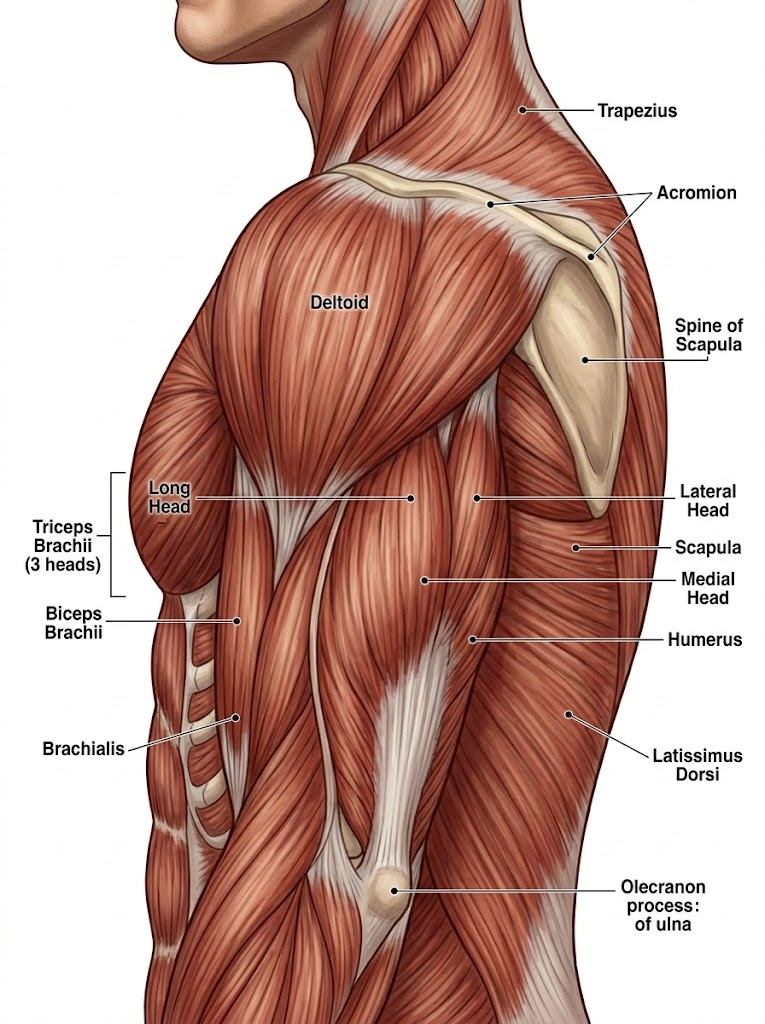
— arms
Biceps + Brachialis + Triceps Long Head
arms.png
Biceps · Brachialis · Triceps (3 heads)
1 — Incline DB Curl
isolation
arm hangs behind the torso → biceps long head loaded at its longest length.
probably the single most effective bicep exercise based on stretch-mediated
hypertrophy research. creates the peak. [8] [18]
2 — Hammer Curl
isolation
neutral grip shifts load from biceps to brachialis. brachialis sits under the bicep —
growing it physically pushes the bicep up, increasing arm peak height. [18]
3 — Overhead Cable Extension
isolation
triceps long head is ~55% of total tricep mass. it's only fully lengthened with arms overhead.
pushdowns don't stretch the long head at all.
if you only do pushdowns you're building the smaller heads. [8] [19]
— legs
Quads + Hamstrings + Calves
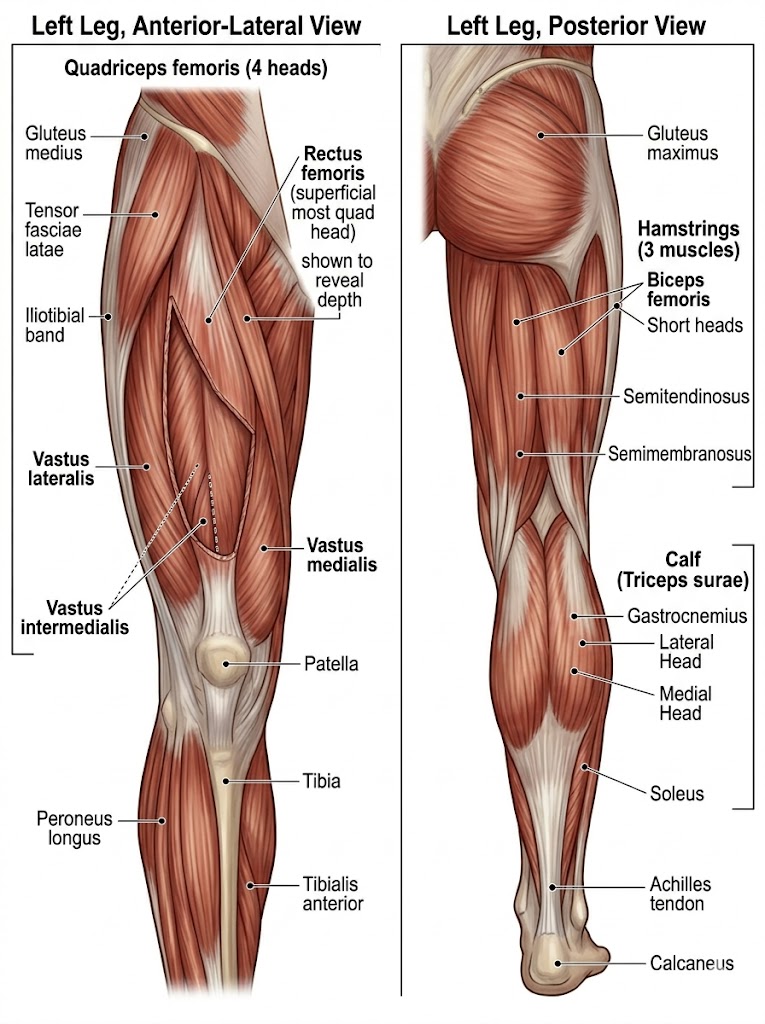
legs.png
Quads · Hamstrings · Gastroc · Soleus
1 — Squat or Hack Squat
compound
deep squats (below parallel) load all 4 quad heads at a longer length than partial squats.
research shows significantly greater quad hypertrophy with full depth. full ROM every rep. [20]
2 — Romanian Deadlift
compound
gold standard hamstring exercise. loads hamstrings in a stretched position —
consistently outperforms leg curl for growth, especially biceps femoris long head.
feel the stretch, not the pump. [21]
3 — Leg Extension
isolation
rectus femoris is the only quad head that crosses both hip and knee.
during squats your hip is flexed → rectus is shortened → can't be fully loaded.
leg extension is the only exercise that fully trains it. [22]
4 — Standing Calf Raise
isolation
calves aren't hit enough by compound work to grow. standing targets gastrocnemius,
seated targets soleus. full ROM — heel below the platform — is critical.
15–25 reps suits slow-twitch dominant fibers. [23]
full body, every other day. two workouts (A and B) alternated.
week 1: A/B/A. week 2: B/A/B. every muscle hits 3× per week.
rest days between sessions are not optional — that's when growth happens. [24]
session length: 60–75 min. rest 2–3 min between compound sets, 90s between isolation sets.
Week 1
MonA
Tue—
WedB
Thu—
FriA
Sat—
Sun—
Week 2
MonB
Tue—
WedA
Thu—
FriB
Sat—
Sun—
— Workout A
| # | Exercise | Sets | Reps | RIR | Coaching note |
| 01 |
Squat or Hack Squat |
2 sets | 6–10 | 2 |
Full depth. Control the negative. Heels elevated on plates if ankles restrict depth. |
| 02 |
Incline DB Press 30–45° |
2 sets | 8–12 | 2 |
Elbows ~75° from torso. Big stretch at the bottom. Don't flare. |
| 03 |
Lat Pulldown or Pull-Up |
2 sets | 6–10 | 2 |
Full stretch at the top. Neutral or shoulder-width grip. No kipping. |
| 04 |
Romanian Deadlift |
2 sets | 8–12 | 2 |
Push hips back, feel the hamstring stretch. Bar stays close to legs. |
| 05 |
Overhead Cable Extension rope |
2 sets | 10–15 | 2 |
Arms fully overhead. Full stretch. Slow eccentric. |
| 06 |
Incline DB Curl |
2 sets | 10–15 | 2 |
Arm hangs behind torso. No swinging. Slow negative. |
| 07 |
Cable Lateral Raise |
2 sets | 12–15 | 2 |
Slight forward lean. Lead with elbow. Full ROM down. |
— Workout B
| # | Exercise | Sets | Reps | RIR | Coaching note |
| 01 |
Overhead Press DB or BB |
2 sets | 8–12 | 2 |
Strict form. Don't turn it into a push press. Full lockout. |
| 02 |
Chest-Supported Row |
2 sets | 8–12 | 2 |
Full stretch forward. Retract scapula at peak. No torso swinging. |
| 03 |
Leg Press |
2 sets | 10–15 | 2 |
Full depth. Don't lock knees out. Feet shoulder-width. |
| 04 |
Cable Fly low-to-high |
2 sets | 12–15 | 2 |
Slight forward lean. Big stretch at bottom. Don't touch hands at top. |
| 05 |
Leg Extension |
2 sets | 12–15 | 2 |
Pause at full extension. Control the eccentric. |
| 06 |
Hammer Curl |
2 sets | 12–15 | 2 |
Neutral grip throughout. No body English. |
| 07 |
Rear Delt Fly cable or pec deck |
2 sets | 12–15 | 2 |
Lead with elbows. Full stretch forward. |
| 08 |
Standing Calf Raise |
2 sets | 15–20 | 2 |
Heel below the step. Full ROM. Pause at top and bottom. |
weekly volume / muscle (averaged across both weeks)
* triceps get indirect volume from all pressing — effective total is higher.
Progressive Overload Rule
track every session. write weight × reps for each set.
when you hit the top of your rep range for 2 sessions in a row — add 2.5 kg.
if you can't hit the bottom of the range, stay at the weight. no ego lifting.
[10]
every 8–10 weeks: one deload week. same exercises, 50% volume, RIR 4–5.
connective tissue needs this. you'll come back stronger after.
[1]Schoenfeld BJ. "The mechanisms of muscle hypertrophy and their application to resistance training." J Strength Cond Res. 2010;24(10):2857-72. pubmed
[2]Krieger JW. "Single vs. multiple sets of resistance exercise for muscle hypertrophy: a meta-analysis." J Strength Cond Res. 2010;24(4):1150-59. pubmed
[3]Schoenfeld BJ, Ogborn D, Krieger JW. "Dose-response relationship between weekly resistance training volume and increases in muscle mass." J Sports Sci. 2017;35(11):1073-82. pubmed
[4]Schoenfeld BJ, Ogborn D, Krieger JW. "Effects of Resistance Training Frequency on Measures of Muscle Hypertrophy." Sports Med. 2016;46(11):1689-97. pubmed
[5]Schoenfeld BJ, et al. "Strength and Hypertrophy Adaptations Between Low- vs. High-Load Resistance Training." J Strength Cond Res. 2017;31(12):3508-23. pubmed
[6]Refalo MC, et al. "Influence of Resistance Training Proximity-to-Failure on Skeletal Muscle Hypertrophy." J Sci Med Sport. 2023;26(1):58-66. pubmed
[7]Helms ER, et al. "Application of the Repetitions in Reserve-Based Rating of Perceived Exertion Scale." Strength Cond J. 2016;38(4):42-49.
[8]Maeo S, et al. "Greater Hamstrings Muscle Hypertrophy but Similar Damage Protection after Training at Long versus Short Muscle Lengths." Med Sci Sports Exerc. 2021;53(4):825-37. pubmed
[9]McMahon GE, et al. "Impact of range of motion during ecologically valid resistance training protocols on muscle size, subcutaneous fat, and strength." J Strength Cond Res. 2014;28(1):245-55. pubmed
[10]American College of Sports Medicine. "Progression Models in Resistance Training for Healthy Adults." Med Sci Sports Exerc. 2009;41(3):687-708. pubmed
[11]Lauver JD, et al. "Influence of bench angle on upper extremity muscular activation during bench press." Eur J Sport Sci. 2016;16(3):309-16. pubmed
[12]Gentil P, et al. "Effect of adding single-joint exercises to a multi-joint resistance-training program." Asian J Sports Med. 2015;6(2):e24057. pubmed
[13]Andersen V, et al. "Effects of grip width on muscle strength and activation in the lat pull-down." J Strength Cond Res. 2014;28(4):1135-42. pubmed
[14]Fenwick CMJ, et al. "Comparison of different rowing exercises: trunk muscle activation and lumbar spine motion." J Strength Cond Res. 2009;23(2):350-58. pubmed
[15]Saeterbakken AH, Fimland MS. "Effects of body position and loading modality on muscle activity in shoulder presses." J Strength Cond Res. 2013;27(7):1824-31. pubmed
[16]Coratella G, et al. "Front vs. Rear-Deltoid Activation in Shoulder Press and Raises." J Hum Kinet. 2020;74:19-28. pubmed
[17]Pizzari T, et al. "Modifying a shrug exercise can facilitate the upward rotator muscles of the scapula." Clin Biomech. 2014;29(2):201-05. pubmed
[18]Oliveira LF, et al. "Effect of the shoulder position on the biceps brachii EMG in different dumbbell curls." J Sports Sci Med. 2009;8(1):24-29.
[19]Kassiano W, et al. "Greater Gastrocnemius Muscle Hypertrophy After Partial Range of Eccentric Contractions at Long Versus Short Muscle Lengths." J Strength Cond Res. 2023;37(9):1919-28. pubmed
[20]Bloomquist K, et al. "Effect of range of motion in heavy load squatting on muscle and tendon adaptations." Eur J Appl Physiol. 2013;113(8):2133-42. pubmed
[21]Bourne MN, et al. "Impact of the Nordic hamstring and hip extension exercises on hamstring architecture and morphology." Br J Sports Med. 2017;51(5):469-77. pubmed
[22]Swinton PA, et al. "A biomechanical comparison of the traditional squat, powerlifting squat, and box squat." J Strength Cond Res. 2012;26(7):1805-16.
[23]Riemann BL, et al. "Medial and lateral gastrocnemius activation differences during heel-raise exercise." J Strength Cond Res. 2011;25(3):634-39. pubmed
[24]Tang JE, et al. "Resistance training alters the response of fed state mixed muscle protein synthesis in young men." Am J Physiol. 2008;294(1):R172-8.
[25]Schoenfeld BJ, Aragon AA. "Is There a Postworkout Anabolic Window of Opportunity for Nutrient Consumption?" J Orthop Sports Phys Ther. 2018;48(12):911-14. pubmed